


Rail transport

|
Warning! This article has yet to be cleaned up to a higher standard of quality, per our Cleanup Project. It may contain factual errors and nonsense, as well as spelling, grammar and structure issues, or simply structure problems. Reader's discretion is advised until fixing is done. |  |
|---|---|---|
You can help clean up this page by correcting spelling and grammar, removing factual errors and rewriting sections to ensure they are clear and concise, and moving some elements when appropriate. |

| |

| |
| Rail transport | |
|---|---|
| General information | |
| Faction | |
| Type | |
| Used by | |
Rail transport such as trains, trams, monorails, railway tracks and train stations are recurring themes throughout the Half-Life series. At numerous points in every one of the games (excluding Portal), the player encounters one or more moving or stationary locomotives, lone carriages, or full-length coupled trains. There are also several instances where the player must cross or follow railway tracks, either on foot, non-rail vehicle, riding in or on the train itself, or by use of an electric monorail, the latter a prominent feature in the original Half-Life game.
Types of rail vehicles
[edit]Black Mesa uses two main types of monorail. One is provided for the security and convenience of the Black Mesa personnel, and rides along the Black Mesa Transit System. The second is a freight monorail used in the Sector E Materials Transport.
Regular trains are used to bring supplies to the Black Mesa Research Facility using the New Mexico Railroad Line. This is managed in Black Mesa's Freight Yard predominantly featuring freight trains.
Half-Life 2 and its Episodes
[edit]
Three trainstations are featured in Half-Life 2 and its Episodes: the City 17 Trainstation and the Depot in Half-Life 2 and the Technical Trainstation in Episode One, although the Citadel also features a train depot.
The Combine heavily use the existing railway. They mostly use it for troop and Stalker transport in Combine-designed Razor Trains. Also, old existing human trains are recycled for Citizen transportation among the Combine-ruled cities, the Combine recycling human technology for their needs. This is in that kind of train Gordon Freeman wakes up at the start of Half-Life 2. The train in which the player arrives in City 17 is pulled by a railcar based on the DR1 DMU railcar produced in Riga, Latvia. Coupled with units from a different train, it is used by the Combine like a locomotive. The DR1 and its modifications (DR1P, DR1A, etc.) are common DMU trains in post-Soviet countries (Russia, Belarus, Ukraine, Latvia, Lithuania, Estonia, etc.). The freight train locomotive seen in Episode Two seems to be based on the Russian TEM2 diesel-electric freight locomotive.
In Episode One, Gordon and Alyx leave City 17 on a regular train as the Citadel Core explodes. In Episode Two, their train has crashed in the Outlands.
The train using the railway linking Combine outposts located in the Wasteland is called the "Wasteland Train".[1]
Train tracks can be found in Ravenholm, and a track-mounted Zombie defense is present in a small mining section between the town and Shorepoint. The Victory Mine complex also features an old mining network where rusty carts can be found.
Tram tracks can be seen on some streets in City 17, but no trams are present in the game.
|

In Half-Life: Alyx, regular trains are featured, and Alyx goes through several stations of the City 17 Metro early on her journey.
Railways as a literary device
[edit]
The train ride at the start of Half-Life as well as the player's path through the City 17 Trainstation at the start of Half-Life 2 were meant to reveal the story setting to the player. In Half-Life, the story would unfold on a fixed rail, while in Half-Life 2, it would unfold at the player's own speed, and come about through interaction with the characters naturally found in that setting.[2]
Railways, along with roads, rivers, and other paths, have long been used in literature and visual arts as a device representing a journey taking place, such as the railway in the film Stand By Me, or the River Congo in Joseph Conrad's novella Heart of Darkness.
Valve might have not intended this consciously when developing the environments with which the characters interact, but the effect of the motif's appearance throughout the series is a constant symbol and reminder of the long and often difficult journey each character is making as the games progress. The implications of these journeys often include an "inner journey" that each character undertakes parallel to the physical one, emerging at the end having gained something metaphysical, like a greater sense of self, a broader understanding of the world, or inner and outer strength.
In the Half-Life series, Gordon Freeman, because of the circumstances he finds himself in, is forced to be brave and strong, and endure tasks he was not prepared to undertake. In this way, he follows a "path" throughout his experiences, and is a stronger person for it.
In addition, trains could symbolize the linearity of the series, both in gameplay and in plot, and the theme of free will (or lack thereof). It is heavily implied by the G-Man, throughout the series, that Gordon's free will and choice is but an illusion. The constant appearance of trains throughout the series reflect this, as trains move in one direction along a set track; in a way, their path is already determined, much like Gordon's journey was determined and orchestrated by the G-Man without Gordon's say in the matter.
Behind the scenes
[edit]
The railway theme was decided to be a major theme along the Coast very early in the development of Half-Life 2, although it was initially even more present.[3] At some point, Gordon was to ride along the coast on a train; the vignette Alyx has his train crashing near the Air Exchange, meeting Alyx and Skitch there and being attacked by the Combine. While Gordon rides the Coast with the Buggy and on foot, the idea was kept for Alyx who arrived at the Depot by train.[1]
City 17 was originally to feature trams; one tram can be found in the E3 map e3_c17_02. Parts of that map were recycled in the Half-Life 2 map d3_c17_13, the last map of the chapter "Follow Freeman!", where tracks and a shelter can still be seen. Furthermore, an early test map, prefab_streets_blvd, features a boulevard with trams going in both directions.[4] Moreover, an elevated railway for the Razor Train bringing Citizens into City 17 (a normal terrestrial train in the final version) was to cross the Combine Factories.[4]
Before trams, school buses were to be used as the primary local transportation.[4]
Gallery
[edit]Concept art
[edit]Half-Life
[edit]-
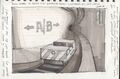 Concept art for the Black Mesa Transit System.

Half-Life 2
[edit]-
 Tram in an early City 17 street.
-
 Inside the early City 17 Trainstation (possibly based on the stenographer's chasm).
-
 Ditto.
-
 Train in City 17.
-
 Railway along the dried seafloor.
-
 A Razor Train locomotive, based on the map
hub_test. -
 Ditto.
-
 Bridge along the coast (based on the WC map pack map
wasteland_railbridge). -
 The Depot.
-
 Razor Train locomotive being lifted in the Depot, based on the WC map pack map
wasteland_depot_inside. -
 Razor Train locomotive handler in the Depot.


Screenshots
[edit]Half-Life and expansions
[edit]-
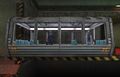 The passenger version of the Black Mesa Transit System monorail car as seen in the opening credits sequence of Half-Life, with G-Man on board.
-
 Inside the passenger monorail in the Black Mesa Transit System.
-
 Pedestrian bridge in the Black Mesa Transit System as seen in Blue Shift.
-
 Freight cars in Black Mesa's Freight Yard.


Half-Life 2
[edit]Pre-release
[edit]-
 Wrecked train cars at the end of the Canals in a Ravenholm prototype map.
-
 Elevated railway and pipes in the Combine Factories area.
-
 Rails passing under an early Trainstation Plaza, in the map
c17_plaza06, a predecessor of the mape3_terminal. -
 A tram in the map
e3_c17_02. -
 Two trams in the map
prefab_streets_blvd. -
 Ditto, side view.
-
 Very basic brush train bringing Gordon to the trainstation in the playable leak.
-
 Early screenshot of the tracks behind the City 17 Trainstation, featuring the Citadel behind, removed from the final version.


Retail
[edit]-
 Railway near the City 17 Trainstation.
-
 City 17 Trainstation main platforms from far.
-
 DR1 DMU power cars in the City 17 Trainstation.
-
 Combine Forcefield Generators along the Canals railway.
-
 A Combine Razor Train passes by a canal and residential apartments.
-
 Wrecked boxcars near Station 1.
-
 ChME3 locomotive near Gate 5.
-
 The same locomotive in the canals.
-
 Stopped freight train on tracks behind Gate 5.
-
 Railroad bridge in the Canals.
-
 Tank cars near Shorepoint Base.
-
 The railway bridge at Bridge Point used by the Combine for moving supplies in and out of Nova Prospekt.
-
 Under the Bridge Point bridge.
-
 Ditto.
-
 Ditto, in the fog.
-
 Razor Train passing on the Bridge Point bridge.
-
 A DR1 Locomotive stopped after disabling the Force Fields at Bridge Point.
-
 A ravaged City 17 street, close to the Citadel wall, with tram tracks.
-
 Razor Train passing by in the Depot.
-
 Razor Train in the Citadel.
-
 Railway in the Half-Life 2: Deathmatch map Underpass.


Half-Life 2: Episode One
[edit]-
 DR1 DMU power cars in the Technical Trainstation.
-
 Barney Calhoun leaving the Technical Trainstation to an unknown destination.
-


Half-Life 2: Episode Two
[edit]-
 Gordon and Alyx's train after the wreck.
-
 Ditto.
-
 Gordon and Alyx's train falling when the bridge is destroyed by the Portal Storm.
-
 The first entrance to the Victory Mine.
-
 Tracks in the Victory Mine area.
-
 TEM2 diesel-electric freight locomotive in the Victory Mine area.
-
 The Victory Mine's small railyard.
-
 Antlion Worker trying to hit the player in the Victory Mine.
-
 Inside the Victory Mine.
-
 Railway and damaged railroad cars near Station 21.


Half-Life: Alyx
[edit]-
 DR1A-224 DMU power car parked at Fairview Junction.
-
 DR1A DMU trailer cars parked at Fairview Junction.


Models
[edit]Half-Life 2
[edit]Pre-release
[edit]-
 The early brush Razor Train locomotive.
-
 TMK 101 tram model.
-
 Train speaker found in the playable leak files.


Retail
[edit]-
 A Razor Train locomotive.
-
 A Razor Train car, closed variant.
-

-
 Boxcar.
-
 Tank car.
-


Half-Life 2: Episode One
[edit]-
 A Razor Train Stalker car.
-
 Train car seen at the end of Episode One.


Half-Life 2: Episode Two
[edit]-
 A TEM2 diesel-electric freight locomotive.
-
 Unused EMD GP60 freight locomotive, originally from Counter-Strike: Source.
-
 Boxcar.
-
 Wrecked boxcar.
-
 Ditto.
-
 Ore hopper.
-
 Tanker car, originally from Counter-Strike: Source.
-
 Mining cart from the Victory Mine, also appearing in Team Fortress 2 with a different texture.


Half-Life: Alyx
[edit]-
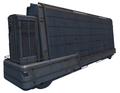 Razor Train car.
-
-
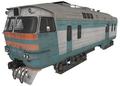
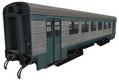 DR1 passenger car.
-
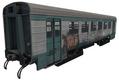 Graffitied variant.
-
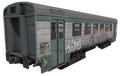 Ditto, opposite side featuring a Vortigaunt.
-
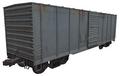 Boxcar.
-
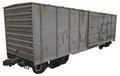 Graffitied variant.
-
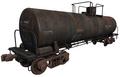 Tanker car.
-
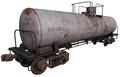 White variant.
-
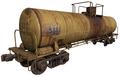 Yellow variant.


List of appearances
[edit]Main games
[edit]- Half-Life
- Half-Life: Opposing Force
- Half-Life: Blue Shift
- Half-Life: Decay
- Half-Life 2
- Half-Life 2: Episode One
- Half-Life 2: Episode Two
- Half-Life: Alyx
Other
[edit]- Half-Life: Day One (First appearance)
- Half-Life 2: Raising the Bar
- Half-Life 2: Deathmatch (Non-canonical appearance)
- Source Particle Benchmark (Game files only) (Non-canonical appearance)
See also
[edit]References
[edit]- ↑ 1.0 1.1 Half-Life 2: Raising the Bar
- ↑ Half-Life 2: Raising the Bar, page 195
- ↑ Half-Life 2: Raising the Bar, page 175
- ↑ 4.0 4.1 4.2 WC map pack
External links
[edit]- "Trains In Games - Half Life 2" on TrainInGames.com