

Shield Scanner
For other uses, see Scanner (disambiguation). |

| |

| |
| Scanner Type II | |
|---|---|
| General information | |
| Faction | |
| Type |
Bio-machine[1] |
| Individual information | |
| Health |
30[2] |
| Weapon(s) | |
| Game information | |
| Entity |
|
| Designer(s) | |
The Shield Scanner, also known as Scanner Type II,[2] is the bio-mechanical counterpart of the City Scanner which appears briefly in the later chapters of Half-Life 2 and at the end of Episode One.
Contents
Overview[edit]

The Shield Scanner is a hovering craft that features a rounded brown hull and a searchlight and is equipped with a large retractable synthetic pincer arm. This tentacle-like arm is normally kept concealed behind an armored lid which has a red Combine insignia printed on it, and is used to drop Hoppers in combat areas where the Combine forces aim to limit the enemy's movement, such as streets and alleys, though occasionally the Scanner will also attempt to drop the mine on top of the player.
When not deploying mines, Shield Scanners are used for scouting and reconnaissance purposes. They also sometimes accompany Striders and act as spotters for them, searching buildings to report the positions of possible concealed targets inside which the Strider would otherwise be unable to see. Like City Scanners, Shield Scanners can temporarily blind targets with their searchlight, but with a longer-lasting flash. Shield Scanners are also similarly powered by a single battery which can occasionally be salvaged from them when destroyed and reused for the HEV Suit. However, it does not mirror the City Scanners' tactic of attempting to crash into its attacker when critically damaged.
Behind the scenes[edit]
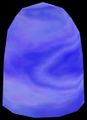
Originally, the Shield Scanner was to protect other Combine units with an energy shield[3][5] and be equipped with an undetermined grenade weapon, possibly the same one to be used by the Mortar Synth.[6] The energy shield model, Scanner_Shield.mdl, can be found in the playable Half-Life 2 leak files, but in wireframe mode, only its shape could be observed, as its texture does not display (it can, however, be found in the Shield Scanner texture folder). The shield appears as some sort of bell jar, presumably used to encase a Combine squad member inside for protection. Additionally, a quick-firing machine gun dealing 3 points of damage per hit on the Shield Scanner is mentioned in the Half-Life 2 Prima Guide that is not present in the final game.[2]
In its texture files, the Shield Scanner is referred to as the "mine layer". A view of the Shield Scanner in the SDK model viewer reveals animation sequences that show it slashing and attacking targets with its claw. This is never seen in-game.
Although the Half-Life 2 leak Shield Scanner uses a separate entity, npc_sscanner, in Half-Life 2, the Shield Scanner is hard coded to only be present in the City 17 levels during the Uprising; in any map with a name that uses the d3_c17 prefix, all npc_cscanner entities, which are normally City Scanners, are forcefully replaced by Shield Scanners. Episode One reintroduces a separate entity for Shield Scanners under a different name, npc_clawscanner.
Gallery[edit]
Pre-release[edit]

Shield Scanner displaying its pincer arm, early skin.
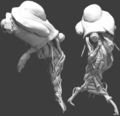
Preliminary plasticine modeling for the Shield Scanner.

Untextured Shield Scanner model.

The cut shield model, viewed in wireframe mode.

Shield model texture.
Fan-restored model.


Retail[edit]

Red "clamp" Combine logo featured on its body.

Truncated white "CMB" Combine logo featured on its body.

A Rebel fighting off two Shield Scanners.
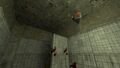
A Shield Scanner in the parking lot.
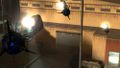
Shield Scanners about to drop Hoppers near the Technical Trainstation.
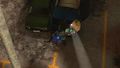
Shield Scanner about to drop a Hopper near the Technical Trainstation.
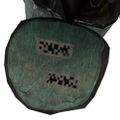
Markings seen inside the Shield Scanner's cap similar to a DNA fingerprint. Each is actually the other rotated 180 degrees.

The first marking isolated.

The second marking isolated.


List of appearances[edit]
Main games[edit]
- Half-Life 2 (First appearance)
- Half-Life 2: Episode One
Other[edit]
- Half-Life 2: Raising the Bar
- Source Particle Benchmark (Game files only) (Non-canonical appearance)
See also[edit]
References[edit]
- ↑ Half-Life 2: Raising the Bar (uncorrected proof), page 277
- ↑ 2.0 2.1 2.2 2.3 Half-Life 2 Prima Guide
- ↑ 3.0 3.1 Half-Life 2 leak
- ↑ Half-Life 2: Raising the Bar, page 83
- ↑ Source SDK files
- ↑ Half-Life 2 leak source code

